VOLCANOES

 A Volcano
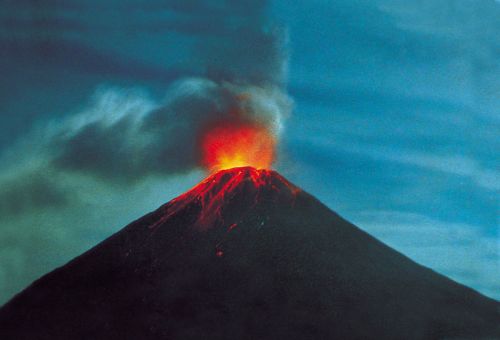
is a vent in the earth through which hot gases and molten rock rise to the surface.
A coneshaped mountain of erupted material around such a vent is also called a volcano.
The name is taken from Vulcano, an island north of Sicily in the Mediterranean Sea. The island was given its name by the ancient Romans because it spewed smokelike vapor, and was thought to be the home of Vulcan, their god of fire.
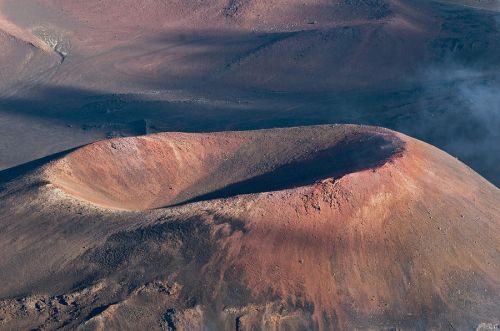
A Volcano consists of a fissure in the earth's crust, above which a cone of volcanic material has accumulated. At the top of the cone is a bowl-shaped vent called a crater. The cone is formed by the deposition of molten or solid matter that flows or is ejected through the vent from the interior of the earth.
The study of volcanoes and volcanic phenomena is called volcanology.
Most volcanoes are composite landforms built up partly of lava flows and partly of fragmental materials. Italy's Mount Etna, in Sicily is an example of a composite cone.
In successive eruptions, the solid materials fall around the vent on the slopes of the cone, while lava streams issue from the vent and from fissures on the flanks of the cone. Thus, the cone is built up of layers of fragmental materials and flows of lava, all inclined outward away from the vent.
Some enormous, crater like basins, called calderas, at the top of long- dormant or extinct volcanoes, are eventually occupied by deep lakes, such as Crater Lake in Oregon.
Some calderas are the result of cataclysmic explosions that destroy the erupting volcano. Others form when the subterranean magma chamber, emptied by repeated eruptions, can no longer support the weight of the volcanic pile above it. Therefore it collapses.
A Volcano
is a vent in the earth through which hot gases and molten rock rise to the surface.
A coneshaped mountain of erupted material around such a vent is also called a volcano.
The name is taken from Vulcano, an island north of Sicily in the Mediterranean Sea. The island was given its name by the ancient Romans because it spewed smokelike vapor, and was thought to be the home of Vulcan, their god of fire.
A Volcano consists of a fissure in the earth's crust, above which a cone of volcanic material has accumulated. At the top of the cone is a bowl-shaped vent called a crater. The cone is formed by the deposition of molten or solid matter that flows or is ejected through the vent from the interior of the earth.
The study of volcanoes and volcanic phenomena is called volcanology.
Most volcanoes are composite landforms built up partly of lava flows and partly of fragmental materials. Italy's Mount Etna, in Sicily is an example of a composite cone.
In successive eruptions, the solid materials fall around the vent on the slopes of the cone, while lava streams issue from the vent and from fissures on the flanks of the cone. Thus, the cone is built up of layers of fragmental materials and flows of lava, all inclined outward away from the vent.
Some enormous, crater like basins, called calderas, at the top of long- dormant or extinct volcanoes, are eventually occupied by deep lakes, such as Crater Lake in Oregon.
Some calderas are the result of cataclysmic explosions that destroy the erupting volcano. Others form when the subterranean magma chamber, emptied by repeated eruptions, can no longer support the weight of the volcanic pile above it. Therefore it collapses.
12 replies
Active and Dormant Volcanoe
volcano that is erupting or has erupted during
historic times is called active.
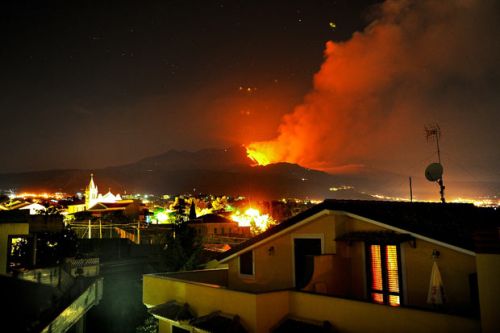 Mt.Etna Italy (active)
A Volcano in whthere is no evidence of any activity is consider extinct.
Volcanoes that appear recent but have
recorded activity other than the quiet escape
are called dormant.
Mt.Etna Italy (active)
A Volcano in whthere is no evidence of any activity is consider extinct.
Volcanoes that appear recent but have
recorded activity other than the quiet escape
are called dormant.
 Some volcanoes are much more active than mt
Stromboli, in the Lipari Islands near Sicily, has
constantly active since ancient times.
Many act volcanoes are found in a belt, called the Ring that circles the Pacific Ocean.
Yet other volcano such as Mount Vesuvius, continue in a state of activity for longer or shorter periods and then become dormant.
The eruption that follows dormancy is violent.
This was shown in the 19 eruption of Mount Saint Helens in the state of Washington. It had been dormant for a period years of being in a dormant state.
The danger posed by active volcanoes is not limited to era of molten rock or showers of ash and cinders.
Mudflows are also equally troublesome.
A mud triggered by an eruption that melted ice and sand on Colombia's Nevado del Ruiz volcano in 198 killed more than 25,000 people.
Some volcanoes are much more active than mt
Stromboli, in the Lipari Islands near Sicily, has
constantly active since ancient times.
Many act volcanoes are found in a belt, called the Ring that circles the Pacific Ocean.
Yet other volcano such as Mount Vesuvius, continue in a state of activity for longer or shorter periods and then become dormant.
The eruption that follows dormancy is violent.
This was shown in the 19 eruption of Mount Saint Helens in the state of Washington. It had been dormant for a period years of being in a dormant state.
The danger posed by active volcanoes is not limited to era of molten rock or showers of ash and cinders.
Mudflows are also equally troublesome.
A mud triggered by an eruption that melted ice and sand on Colombia's Nevado del Ruiz volcano in 198 killed more than 25,000 people.
Mt.Etna Italy (active)
A Volcano in whthere is no evidence of any activity is consider extinct.
Volcanoes that appear recent but have
recorded activity other than the quiet escape
are called dormant.
Some volcanoes are much more active than mt
Stromboli, in the Lipari Islands near Sicily, has
constantly active since ancient times.
Many act volcanoes are found in a belt, called the Ring that circles the Pacific Ocean.
Yet other volcano such as Mount Vesuvius, continue in a state of activity for longer or shorter periods and then become dormant.
The eruption that follows dormancy is violent.
This was shown in the 19 eruption of Mount Saint Helens in the state of Washington. It had been dormant for a period years of being in a dormant state.
The danger posed by active volcanoes is not limited to era of molten rock or showers of ash and cinders.
Mudflows are also equally troublesome.
A mud triggered by an eruption that melted ice and sand on Colombia's Nevado del Ruiz volcano in 198 killed more than 25,000 people.VOLCANO : DATE OF ERUPTION ACTIVITY
Popocatepetl, Mexico: December 6, 1997
Bezymianny,
Kamchatka December 5, 1997
Kilauea, Hawaii 1983-continuing
Ruapehu, New Zealand October, 1997
Adatara, Honshu, Japan September 15, 1997
Karymsky, Kamchatka,
Russia: August 2, 1997
Etna, Sicily, Italy July 31, 1997
Pavlof, Alaska June 3, 1997
Merapi, Indonesia Nov 22, 1994
Fogo, Cape Verde April 2, 1995
Akutan, Alaska: March 10, 1996
Mount St. Helens January 1 - Septembe
1995
Cerro Negro,
Nicaragua: November 30, 1995
Hosho, Kyushu, Japan October 12, 1995
Location and Causes of Volcanoes
There are about 2,500 known active volcanoes
world.
Nearly all of them are located in chains
stretching across the earth, often for many
thousands of miles.
Geologists believe that this
distribution is related to a theory of the develo
of the earths surface called plate tectonics.
The plate tectonics theory says that the surface
the earth is divided into segments, called plate
which are moving relative to one another. Wh
two adjacent plates are moving away from eac
other material rises from beneath the plates to
the gap, which is therefore marked by a line of
volcanoes.
In the opposite situation, in which two plates a
moving together, a string of volcanoes is also
developed by the melting of one plate as it des
beneath the other. The Pacific Ocean is nearly
surrounded by such lines of collision between
along which are located two thirds of the world
active volcanoes, forming the "ring of fire".
A third type of volcanic chain is formed when
plate moves over what appears to be a "hot sp
deep in the earth. Volcanoes formed when ove
hot spot are carried away by the motion of the
The Hawaiian Islands are an example of such
chain.
Structure and Formation
At the top of most volcanic mountains is a crater which marks the upper end of the vent.
A large crater, or caldera, may be formed by the collap the mountain top after the withdrawal of mag Crater Lake in Oregon occupies 20 sq mi of a c left by the collapse of Mounth Mazama, an anc extict volcano. Underwater eruptions are come especially in the seas near island arcs. In Japa
1952, a underwater eruption of Myozin-San su
ship with all on board.
Most new volcanoes start on the flanks of olde
ones, forming adventive cones. Paricutin was
on Feb. 20 1943 in the state of Michoacan, Mex
Gases and hot ashes began to emerge from a fi
in a cornfield, and soon later a cone 30 ft high
been built around the vent. In a week it had gr
to 450 ft and the roar of the eruption was hear
mi away. When its activity ceased nine years l
the volcano had built a cone 1,300 ft high and
lava had buried two towns
products of Volcanoes
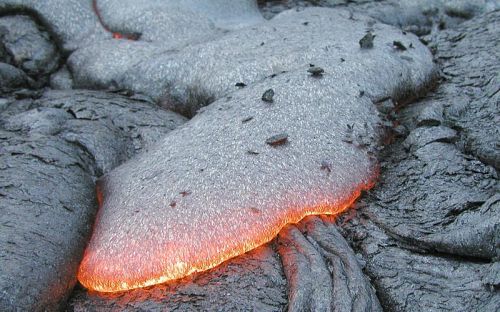 Volcanoes can emit gases, molten rock, or solid
particles. Volcanic gases are composed mainly
water vapor, hydrogen, hydrogen chloride, hyd
sulfide, carbon monoxide, and carbon dioxide.
The molten rock, or magma, that rises in a volcano
is called lava after it flows out at the surface. and hardened lava may have either a smooth rough surface. Smooth lava, called pahoehoe, ropy, folded surface. Rough clinkery lava is cal
aa. Both words are of Hawaiian origin. The ga
remaining in lava after its eruption forms bub
which leave small holes, or vesicles, in the har
rock. Scoria is hardened lava that contains magma vesicles.
Magma Composition and Origin
The kind of material erupted depends on the n
of the eruption, which in turn is related to the
magma composition. Magmas are classified by
amount of silica that they contain. Eruptions o
material are usally quiet outporuings of lava t
cools to form a dark colored rock called basalt.
magmas contain about two thirds silica. They
stiff and viscious, and gases are released explo
after building up enough pressure to shatter th
magma.
The earth's interior, below the thin crust, was
thought to be entirely molten. It is now known
most of the earth is solid rock, and that only p
the central core is liquid. Most magma comes f
pockets in the upper mantle--the thick, normall
solid layer between the crust and the core. The
material erupted from Hawaii's volcanoes is fr
depth of about 40 mi.
Volcanoes can emit gases, molten rock, or solid
particles. Volcanic gases are composed mainly
water vapor, hydrogen, hydrogen chloride, hyd
sulfide, carbon monoxide, and carbon dioxide.
The molten rock, or magma, that rises in a volcano
is called lava after it flows out at the surface. and hardened lava may have either a smooth rough surface. Smooth lava, called pahoehoe, ropy, folded surface. Rough clinkery lava is cal
aa. Both words are of Hawaiian origin. The ga
remaining in lava after its eruption forms bub
which leave small holes, or vesicles, in the har
rock. Scoria is hardened lava that contains magma vesicles.
Magma Composition and Origin
The kind of material erupted depends on the n
of the eruption, which in turn is related to the
magma composition. Magmas are classified by
amount of silica that they contain. Eruptions o
material are usally quiet outporuings of lava t
cools to form a dark colored rock called basalt.
magmas contain about two thirds silica. They
stiff and viscious, and gases are released explo
after building up enough pressure to shatter th
magma.
The earth's interior, below the thin crust, was
thought to be entirely molten. It is now known
most of the earth is solid rock, and that only p
the central core is liquid. Most magma comes f
pockets in the upper mantle--the thick, normall
solid layer between the crust and the core. The
material erupted from Hawaii's volcanoes is fr
depth of about 40 mi.
Volcanoes can emit gases, molten rock, or solid
particles. Volcanic gases are composed mainly
water vapor, hydrogen, hydrogen chloride, hyd
sulfide, carbon monoxide, and carbon dioxide.
The molten rock, or magma, that rises in a volcano
is called lava after it flows out at the surface. and hardened lava may have either a smooth rough surface. Smooth lava, called pahoehoe, ropy, folded surface. Rough clinkery lava is cal
aa. Both words are of Hawaiian origin. The ga
remaining in lava after its eruption forms bub
which leave small holes, or vesicles, in the har
rock. Scoria is hardened lava that contains magma vesicles.
Magma Composition and Origin
The kind of material erupted depends on the n
of the eruption, which in turn is related to the
magma composition. Magmas are classified by
amount of silica that they contain. Eruptions o
material are usally quiet outporuings of lava t
cools to form a dark colored rock called basalt.
magmas contain about two thirds silica. They
stiff and viscious, and gases are released explo
after building up enough pressure to shatter th
magma.
The earth's interior, below the thin crust, was
thought to be entirely molten. It is now known
most of the earth is solid rock, and that only p
the central core is liquid. Most magma comes f
pockets in the upper mantle--the thick, normall
solid layer between the crust and the core. The
material erupted from Hawaii's volcanoes is fr
depth of about 40 mi.Types of Eruptions
Icelandic - Volcanic eruptions may be classifie
order of increasing violence. Icelandic eruptio
involve the quiet outpouring of lava from long
fissures. Most than 2 1/2 cu mi of lava flowed f
Iceland's Lake Fissure in 1783, the largest emis
lava in historic times. Eruptions of the Icelandi
during the Tertiary Period built up vast basalt
plateaus in many parts of the World. One of th
largest is the Columbia Plateau, more than 20,0
mi in the northwestern United States.
Hawaiian - Lava issues from a single vent in
eruptions of the Hawaiian type. Each flow adds
of rock to a broad, gently sloping mountain cal
shielt volcano. In calderas at their summits shi
volcanoes may contain lava lakes in which lav
continuosly circulates from below. The volcano
Niragongo in Africa contains a lava lake, as di
Kilauea in Hawaii. The escape of gas at the ve
during Hawaiian erputions often produces lava
fountains several hundred feet high.
Strombolian - Continuos eruptions that emit s
of lava at rhythmic intervals are called stromb
after the volcano Stromboli, north of Sicily. Mu
the erupted material is fragmental, so that the
steep sided. A cross section would show altern
layers of pyroclastic material and lava flows, f
a mountain known as a stratovolcano.
Vulcanian - In Vulcanian eruptions, which also
produce stratovolcanoes, the magma is more a
less fluid than in the preceding types. The ope
phase is explosive, blowing away the thick cru
the vent and often destroying part of the moun
Lava flows may emerge later. Both Vulcano, fr
which such eruptions are named, and Italy's
Vesuvius illustrate this type of activity. In 79 A
eruption of Mount Vesuvius buried the city of
under a layer of pumice, and many of its 20,00
inhabitants were killed. A nearby city, Hercula
was buried by a lahar, or mudflow, caused by
that accompanied the eruption. A single Vulca
eruption where none has occurred before prod
cinder cone, or pyroclastic cone, surrounded b
flows. Paricutin is an example.
pelean - The most explosive eruption is the Pel
type, named for the 1902 eruption of Mount Pel
the island of Martinique in the West Indies. On
morning of May 8 a blast of steam and red-hot
shot laterally from the volcano and destroyed t
of Saint Pierre and all but two of more than 26
inhabitants. This was the greatest loss of life e
known to result directly from an eruption, alth
80,000 lives were lost in the famine that was c
by the eruption in 1815 of Tambora in the East
The blast that destroyed Saint Pierre was a nu
ardente, a stream of ash-laden gas that forced
passage through the viscous magma that clogg
crater. Some months later a volcanic spine, or
of stiff lava, arose from the crater. It reached a
of 1,020 ft above the crater floor before collapsi
predicting and Controlling Eruption
There are a few ways to predict future volcanic
activity. The first method, which is the most w
used, is to study the geographic area where th
volcano resides. Usually, volcanoes may produce
many small earthquakes preceeding a volcanic
eruption, as Mount Saint Helens did in Washinton
in 1980. Vulcanologists are continually studyin
these and other effects, such as increases in th
temperature of the volcano, to find ways of giv
warning of an coming eruption.Although there
seems to be little man can do to prevent an
eruption, some attempts to lessen the damage
caused by lava flows have been successful. Stre
of lava have been diverted from a course whic
threatened to overwhelm a town by bombing t
flow nearer the eruption vent and diverting th
lava into another area. Slowing part of a flow
building walls or by cooling the lava with strea
water may be possible in some cases.
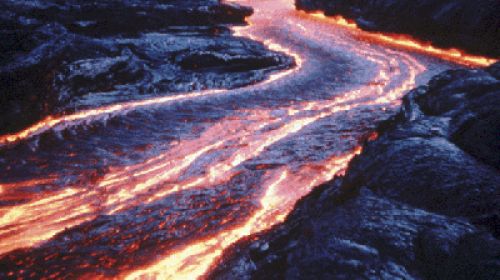
Theories of Volcanism
Geologists have incorporated volcanism into th
theory of plate tectonics. Their theory says tha
active volcanoes obtain their energy from the
movements of crustal plates. It is because of th
that volcanoes tend to be associated with majo
plate boundaries.
Convergent and divergent are two kinds of plat
boundaries where volcanoes form. When one p
plunges beneath the other, material on the upp
surface of the subducted plate is dragged down
into the earth's crust until it reaches a depth
it becomes molten. It then rises and is ejected
surface through a volcanic vent. At divergent p
boundaries, such as the Mid-Atlantic Ridge, wh
oceanic crust is being stretched and rifted apar
linear zone of weakness forms.
When the volcano of Paricutn erupted in the
of a central Mexican cornfield in 1943, scientist
the opportunity to study the birth and the orde
emited materials firsthand. The lava flows
completely buried the village of Paricutn.

Please Rate/Vote here topic id: 3203727 Rating / Voting Zone ,. .

